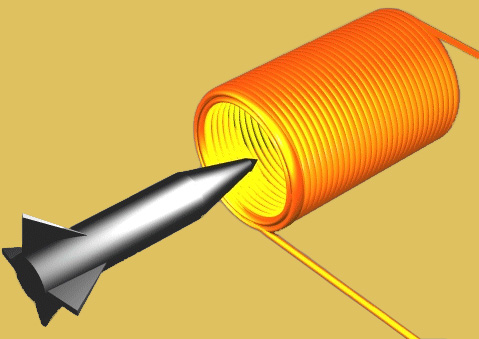
Barry's Coilguns
Coilgun Mark 2
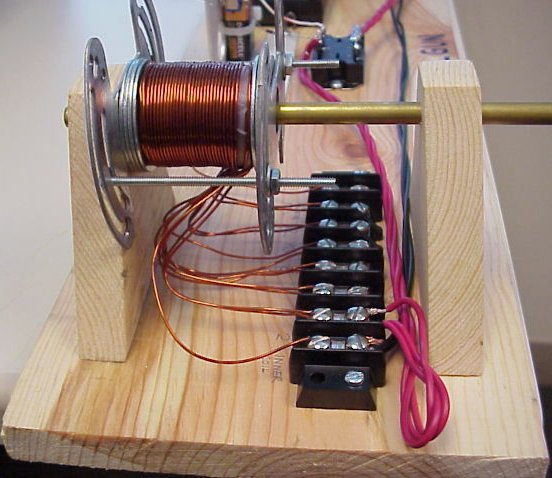
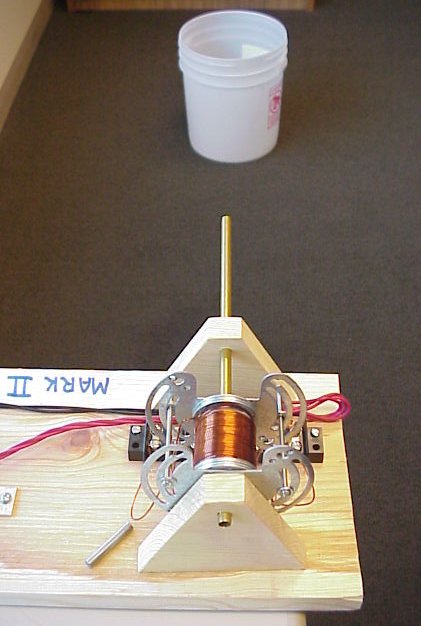
Barry's Coilgun Mark II
What if I made a single-stage coilgun, with capacitive discharge timing? How well can it work?
A coilgun is a great teaching device. As such, it illustrates principles of magnetism and stored energy. Rotary motors are highly refined creatures with a hundred years of development. It is difficult to understand how rotary motors work because they have several things happening at once: multiple poles and multiple windings are all doing their thing together. As the rotor turns, the contacts transfer electrical energy, and the rotary load interacts with the rotational inertia and magnetic fields that come and go. Through some massive oversight, the engineers pretty much ignore all the transients and study the motor as if it were steady-state! In a coilgun there is no such thing as steady-state. Everything that happens is a transient. I find this a very interesting puzzle to analyze.
Goals
My second model, the Mark II, will launch small projectiles at a better speed with simpler construction.
It will be much easier to build, because there are no timer/counter circuits. On the other hand. it will take more fiddling to tune it up. The main goal: minimum part count.
Java Applets
 These Java applets help analyze coils and RLC circuits:
- Hints and Suggestions
- RLC Simulation will show voltage and current over time
- RLC Analysis discusses what the RLC response means to coilguns
- LC Time Simulation will show the time response of LC circuits
- Inductor Simulation will show air-core coil characteristics
- Wire Loop Simulation discusses the math behind a single-turn coil
 Here's
how to build the Mark II:
Here's
how to build the Mark II:
- Photographs
- Schematic Diagram and parts list
- What is an SCR?
- Construction Details
Results
Now here's the results of my measurements and comparisons. I started at low voltage to tune the coilgun, then worked up to higher voltages and different projectiles.
- How does the starting position affect performance?
- How does the number of turns affect performance?
- How does the projectile length affect performance?
- How does the external iron affect performance?
- How does the capacitor voltage affect performance?
- How does the energy efficiency relate to capacitor voltage?
- How does the firing tube material affect performance?
In summary, here is the Mark II coilgun:
- it has the primary goal of minimum parts count
- fires at 9 m/s
- the projectile is 44.7 mm in length and 6.0 mmdiameter, weighing 10.03 g
- the coil is 40 mm long, wound with four layers of 18 AWG copper magnet wire in 30 turns per layer
- there is no external iron
- the capacitor is 24,000 uF, and is charged to 55 volts for a total of 36.3 J
By the way, 9 m/s is equivalent to a flight of eleven feet out and two feet down. Not much danger... except maybe some nearby feet and ankles.
| < Previous | Page 1 of 18 | Next > |
©1998-2026 Barry Hansen